
What are copper fungicides, and how do you use them?
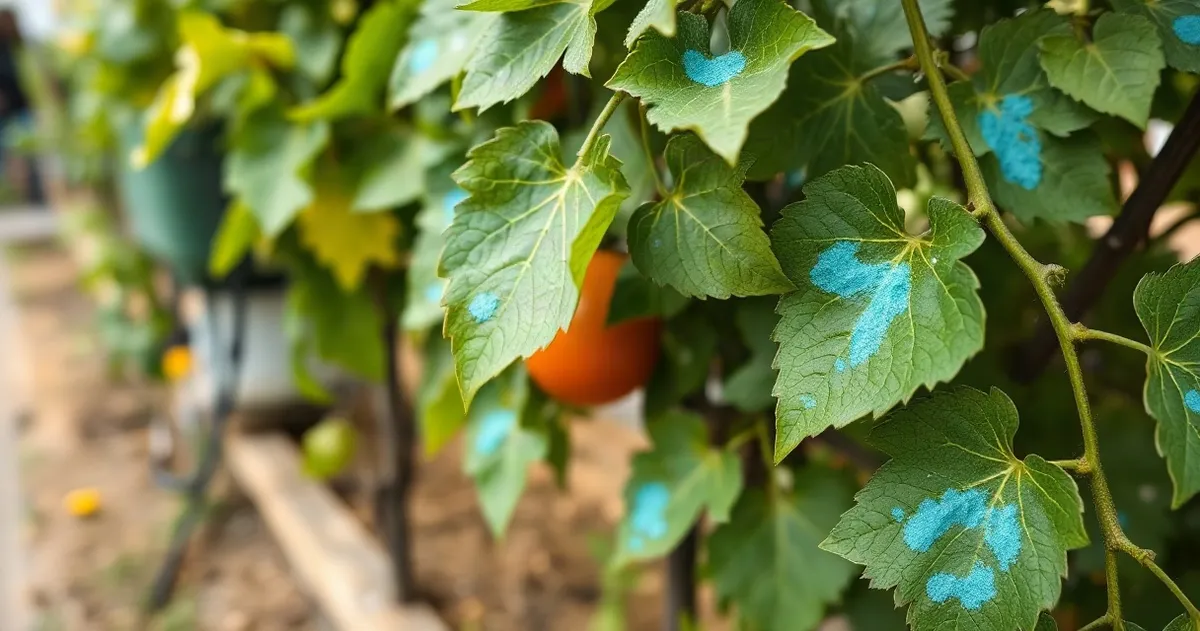
Copper fungicides are the blue-green sprays sold for the vegetable garden: the label says whether the compound is oxychloride, Bordeaux mixture or another copper salt. Use only a product authorised for that crop, at the dose on the label, and do not exceed 28 kg of copper metal per hectare over 7 years.
By region
| North | Centre | South | |
|---|---|---|---|
| The ceiling | 28 kg of copper metal per hectare over 7 years, the same in the centre and the south. In 2026 you count the kilograms already applied from 2020 to 2025. | The same ceiling. The label recommends an average of 4 kg per hectare a year. | The same ceiling. A longer season does not raise it. |
| When it comes in | After the cultural steps, and only on the crop and the disease named on the label. In a cool, wet summer fungal pressure rises. | As in the north. | As in the north. More months of crop mean more temptation to repeat: stay at the minimum needed. |
The ceiling is the law, the same in every region. The dose of a single spray is the one on the label.
Regulation (EU) 2018/1981 set the ceiling to limit accumulation in soil and exposure of non-target organisms, and Regulation (EU) 2025/1489 extended approval of the active substance until 30 June 2029. The Italian Ministry of Health notice for 2026 explains the backward count. On late blight, the cultural steps in the guide come before any product: see pests and diseases.
Which copper
What a garden centre sells under a copper name is not one recipe. Regulation (EU) 2021/1165, for organic production, lists five compounds: copper hydroxide, copper oxychloride, copper oxide, Bordeaux mixture and tribasic copper sulphate. Bordeaux mixture is copper sulphate neutralised with lime. Oxychloride is a different salt. The precise name is on the label of the product authorised by the Italian Ministry of Health.
Use that product, diluted as its label says. A home mix of sulphate and lime is not an authorised label. The extension to 2029 covers authorised products, not a mix you make yourself.
The ceiling
The 2018/1981 text authorises only uses that stay within 28 kg of copper per hectare over 7 years, on average 4 kg per hectare a year. Member States may set an annual maximum that does not exceed 4 kg per hectare. In Italy, from the Ministry of Health notice of 2019, the label has to carry the line: do not exceed 28 kg of copper per hectare over 7 years, and an average of 4 kg per hectare a year is recommended.
From 2026 the count runs backward, because the first 7 years after the 2019 approval have passed. For sprays in 2026, subtract the kilograms applied from 2020 to 2025. For 2027, subtract those from 2021 to 2026. Those are kilograms of copper metal, not the weight of the packet. 28 kg on a hectare, that is on 10,000 m², is 2.8 g of copper metal per square metre over seven years. The recommended average, 4 kg per hectare a year, is 0.4 g per square metre a year. That figure is the ceiling, not the dose of one spray: the dose is on the label.
For organic production, Regulation (EU) 2021/1165 points back to the conditions of Regulation 540/2011 and repeats the same ceiling of 28 kg over 7 years. Organic production does not raise it.
How to use it
The regulation asks that rates and the number of applications do not exceed the minimum needed. The label states the crop, the disease, the dose, the interval and the days before harvest. It also asks Member States for protection of the person spraying and for measures on water and non-target organisms: gloves, a buffer to watercourses and the rest are what is written there.
Start with the cultural steps. On tomato late blight those are rotation, dry leaves and space between plants: the guide is tomato late blight. On courgette powdery mildew the first step is variety, water at the base and air, set out in courgette powdery mildew: copper is used if that product's label allows it on that crop. The wider picture is under pests and diseases.
In the app
The photo check lets you snap a plant and get an indication of its health. It is only an indication, not a firm diagnosis: for serious cases, ask a professional.
Frequently asked questions
Can I mix Bordeaux mixture at home?
No. Use a product authorised by the Italian Ministry of Health, diluted as its label says. The extension of approval to 30 June 2029 covers those products.
Is the ceiling higher in organic growing?
No. Regulation (EU) 2021/1165 allows five copper compounds and stays within 28 kg of copper per hectare over 7 years, in line with Regulation 540/2011.
Is it 4 kg a year or 28 kg over seven years?
The ceiling printed on labels in Italy is 28 kg of copper metal per hectare over 7 years. The label also recommends an average of 4 kg per hectare a year. In 2026, subtract the kilograms applied from 2020 to 2025.
Will copper cure leaves already white with mildew?
The first step on powdery mildew is a resistant variety, water at the base, air, and infected leaves removed. Use copper only if the product label authorises that crop and that disease, at the dose it states.
Should I spray every week to be safe?
No. Regulation (EU) 2018/1981 asks that rates and the number of applications stay at the minimum needed. The interval is the one on the label, in the north as in the south.
Sources
- Commission Implementing Regulation (EU) 2018/1981 – copper compounds
- Commission Implementing Regulation (EU) 2025/1489 – copper approval extended
- Commission Implementing Regulation (EU) 2021/1165 – substances for organic production (consolidated 15 June 2025)
- Ministero della Salute – composti del rame, quantitativi dal 2026