Why do tomato leaves turn yellow?
Yellow tomato leaves are read from where they start: between the veins of old leaves it is often magnesium, on a pale, stalled plant it is often nitrogen, on the young leaves it is often iron. Sort the water out before you feed, because dry or waterlogged soil stops the roots taking anything up, and rule out the blotches of late blight.
By region
| North | Centre | South | |
|---|---|---|---|
| Spring | Below 12 °C (54 °F) the plant struggles. Purple on young leaves in cold soil is usually phosphorus that is not getting in: in cultivated soils a real shortage is rare. | Cold nights after an early planting do the same. Wait for some warmth, then read the leaf. | Cold matters less. Thirst, and a pot that dries out, matter more. |
| Summer | Yellow between the veins of older leaves: often magnesium, especially after a lot of high-potassium feed. If the plant is vigorous, the RHS is not concerned. | As in the north. | As in the north, plus a pot in the heat. Check the water before you feed. |
The yellow follows the leaf and the water, not the month. Planting dates stay the ones in the tomato guide.
The 12 °C (54 °F) figure is from the RHS: below it, a tomato will not thrive. Purple from cold at planting is in its nutrient-deficiency guide, which also says that cultivated soils rarely run short of phosphorus. When to plant out, region by region, is in when to plant tomatoes.
Where the yellow starts
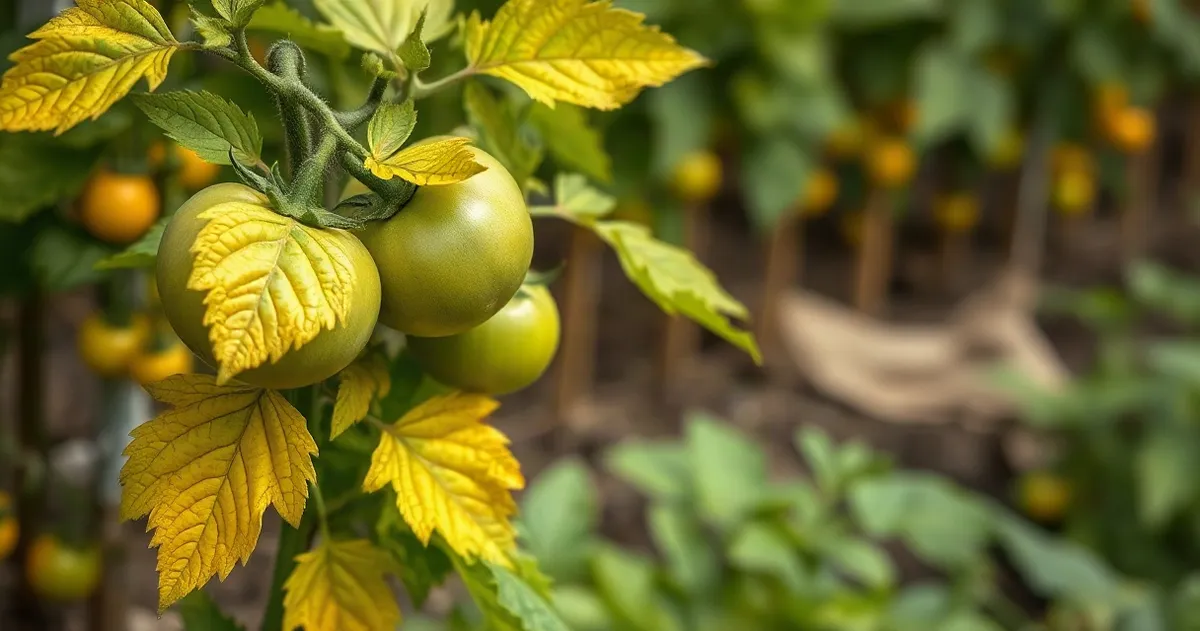
On older leaves the RHS often sees magnesium: yellow between the veins, sometimes with reddish-brown tints, then dead patches and the leaf dropping. If the pattern is only on the older leaves and the plant is otherwise pushing on, it says there is no cause for concern. The same mottling of older leaves, on a vigorous plant, it treats as a lesser problem.
Nitrogen, again from the RHS, makes a spindly, stalled plant with pale yellow leaves, sometimes pink-tinted. It starts on the older leaves and moves up. Cornell, on tomato, describes the same order: the oldest leaves turn chlorotic, the younger ones yellowish-green.
Iron shows on the young leaves, with the veins staying green. Cornell describes it that way on tomato. The RHS says the same about leaf age: iron on the youngest, magnesium on the older ones. On a very chalky soil the iron is there and the roots cannot take it up, and lowering the pH of a soil with free lime, the RHS writes, is not practical.
Water, cold, pots
The RHS warns that drought, waterlogging, low light and a poor planting look like a deficiency. In dry or sodden soil the roots do not take nutrients up, even when the element is in the ground. If the plant has dried out, do not flood it: bring the moisture back gradually. The rhythm is in watering. A black patch on the tip of the fruit, with the leaves otherwise sound, is blossom end rot: uneven water, not a yellowing you feed away.
In a pot, the RHS writes, the nutrients in the compost last 6–8 weeks, and without steady water the roots do not take them up. Sodden compost blocks them too. Pots and watering are in the container garden.
Leaves that curl, with cold nights and hot days, are a separate disorder: the RHS says it usually passes on its own once the nights warm up, and that the crop suffers little. Stripping leaves at random leaves the fruit in the sun: that point is in side shoots.
What to do, and what to leave
Water first, steadily, on the soil. Then read the leaf. A fertiliser poured on at random moves the problem: too much nitrogen, the RHS and University of Minnesota Extension write, makes dark leaves, a lot of growth and fruit that is late. Too much potassium, for the RHS, reduces magnesium uptake, and that is a typical result of tomato feed used to excess.
If the pattern is magnesium and the plant is suffering, on a light, free-draining soil, the RHS gives magnesium sulphate (Epsom salts) on the soil at 30 g per square metre. In summer, as a short-term step, 20 g of Epsom salts per litre of water on the leaves, two or three times over a fortnight, and only under dull cloud: in sun the leaf scorches. If the yellow is only on a few old leaves and the top is green, skip this.
For nitrogen in the open ground, the long fix is a mulch of compost or well-rotted manure. The short one is a nitrogen fertiliser at the rate on the label. How to make the compost is in garden compost, and the layer is in mulching.
Brown blotches that are not stopped by the veins, on leaves, stems and fruit, in cool wet weather, are late blight. Do not feed that: remove the affected parts. The picture is under pests and diseases.
In the app
The photo check lets you snap a plant and get an indication of its health. It is only an indication, not a firm diagnosis: for serious cases, ask a professional.
Frequently asked questions
Should I remove the lower yellow leaves?
If it is only the old leaves and the plant is growing, the RHS says there is no cause for concern. Taking them all off leaves the fruit in full sun, and that fruit scorches.
Do Epsom salts fix it?
Only if the yellow is between the veins of the older leaves and the plant is suffering. On the soil, on light ground, the RHS gives 30 g per square metre. On the leaves, 20 g per litre, two or three times over a fortnight, and only under cloud.
Is it late blight?
Late blight makes brown blotches that spread over leaves, stems and fruit in cool, wet weather. Yellow between the veins, without those blotches, is a different case.
Can tomato feed turn the leaves yellow?
Yes, if you give too much. The RHS writes that excess potassium reduces magnesium uptake. Too much nitrogen, on the other hand, makes a lot of dark leaf and delays the fruit.
Are purple leaves in spring a deficiency?
Below 12 °C (54 °F) a tomato struggles, and purple on young leaves in cold soil is usually phosphorus that is not getting in. In cultivated soils the RHS treats a phosphorus shortage as rare: wait for the warmth given for planting out.
Sources
- RHS – Tomato leaf problems
- RHS – Nutrient deficiencies
- University of Minnesota Extension – Growing tomatoes in home gardens
- University of Minnesota Extension – Quick guide to fertilizing plants
- Cornell Vegetables – Tomato nutrient disorders
- University of Minnesota Extension – Late blight of tomato and potato